Monday, May 28, 2018

EYE STRAIN

Your eyes are such a vital part of every day life. They are how you are reading this blog right now and how you can navigate throughout this world with such ease. With how helpful our eyes are to your everyday life, there is no doubt that your eyes can get very tired. Every one has felt eye strain- after reading or focusing on something for a long time, looking at too bright of a light, not wearing your contacts or glasses. This eye strain can be extremely annoying and can cause some other issues.

Eye strain is described by Medicine Net as "ocular fatigue, tired eyes, blurring, headaches, and occasionally doubling of the vision are brought on by concentrated use of the eyes for visual tasks. By clenching the muscles of the eyelids, face, temples, and the the jaw after extended use of the eyes,  there can become discomfort and pain of those muscles. Other symptoms of eye strain are soreness of the back of the neck, blurry vision, teary and watery eyes, dryness of the eyes, light sensitivity, and headache, which is the most common of all of the symptoms. For people who commonly get headaches, eye strain can cause even worse headaches or possibly migraines. 

Your eye doctor can diagnose you with eye strain if you are experiencing some of these symptoms. From there, they will be able to help you to determine the root of your eye strain, such as an incorrect prescription or astigmatism. Since you are not able to immediately go to the doctor (usually), there are some helpful step-by-step instructions on how to help you to deal with the annoying symptoms of eye strain.

1. Close your eyes.
This may sound simple, but the first step to relieving the eye strain is to stop making your eyes strain. The only way to truly do this is by closing your eyes. This also makes the next few steps WAY more comfortable to do.

2. Gently massage your upper eyelids against your brow bone using your index and your middle finger. 
The image to the right shows where the two fingers should be resting during this gentle massage. Make sure to not hurt yourself or put too much pressure on that area as it is very sensitive and only requires a light pressure to feel results. 

3. Gently massage your lower eyelids against your lower eye socket bone using your index and your middle finger. 
The image to the right shows where the two fingers should be resting during this gentle massage. Follow the same guidelines as the prior step. 

4. Massage the outside of each eye.
Use one finger on both sides to give a gentle massage to the outside of the eyes where the eyeball meets the side of the eye socket. 

5. Massage the front of your temples. 
Use two fingers on both sides of the front of your temples and apply a good amount of pressure. Massage for at least 60 seconds. 

Massage is a very beneficial at-home tool to help with eye strain. If you continue to experience these symptoms, contact your doctor to seek out a further explanation and treatment plan.


Contact us at: 619-917-4675 OR  massagelamesa@gmail.com 
Book now by clicking HERE.


Friday, May 25, 2018

ORANGE ESSENTIAL OIL

Orange!

Orange Essential Oil is a very popular oil that is used throughout the world for it's beneficial properties and can be included in your AromaTherapy session today. DoTerra explains that orange essential oil has a variety of different healing properties for both the mind and the body. 

What is it?

Orange essential oil is the oil extracted and cold pressed from the peel of an orange, a very common variety fruit that can be found in many different places today, but is native to China. Orange is known as the oldest and the most common tree fruit throughout the whole world. Although oranges originated in China, they did begin to move around the world when Christopher Columbus brought orange seeds to the Caribbean and the United States. When the fruit moved to England in the 16th century, oranges were first valued for their medicinal properties before they were even thought of as a fruit. Since the beginning of oranges, people throughout China, the Middle East, and India have used oranges for it's curative effects. According to New Directions Aromatics, some of these conditions that were cured include depression, flu, indigestion, and anorexia.

What does it do?

The most common use of orange essential oil is to improve one's mood and be used as an antidepressant. There are many different mood problems that lemon oil helps. This includes depression, anxiety, and saddness. Because of the calming properties that orange oil holds, it is extremely helpful in all of the mood issues listed before, according to Natural Living Ideas

Another common use for orange oil is to help relieve fatigue. Orange oil has extremely uplifting properties, which is one of the reasons it helps with mood issues, as well. Orange oil has been used since the beginning of it's history for how much it can help one to feel more awake. By using orange oil on your wrists or by aromatically diffusing it in the morning, it can be almost as awakening as your morning coffee, without all the caffeine jitters. Not to mention, orange being diffused around your house is such a beautiful thing to be awakened to every day. 


There are countless uses for orange essential oil that people have found over the years. Some other common uses are to help control any acne and reduce acne scarring. The antiseptic properties helps to clean and reduce the chance of acne on someone with oily skin. This can be done by putting a few drops into a cup of water and washing your face with it every night. Another benefit is how it can help with seasonal allergies and sinuses by inhaling the scent when you feel that you are beginning to get an itchy nose or if your sinuses begin to get clogged. Many people carry around a cottontail with the oil on it to inhale when they start to feel themselves about to sneeze or any other allergic reactions.

How do you use it?
Like discussed in a past blog, essential oils can be used through topical application, ingestion, or aromatic application. The same goes for orange essential oils. Topically, one could use orange oil to help acne, however, would not be recommended for some skin conditions due to the acidity. It can be added to water like for some it's internal benefits.  It can even be used through aromatic diffusion to improve overall emotions, mood, and upset within the body and mind. 

As you can tell, orange essential oil is an essential part of everyone's natural kit of remedies. Through the proper use of orange and other essential oils, you can improve your overall health- the natural way! If you would like to learn more about orange or any other essential oils, feel free to click here to be brought to the official doTerra page.


Contact us at: 619-917-4675 OR  massagelamesa@gmail.com 
Book now by clicking HERE.

Wednesday, May 23, 2018

HISTORY OF MASSAGE

I don't know about you, but when I love something, I want to know EVERYTHING about it. This is definitely the case when we are talking about massage. There have plenty of blogs that discuss the many aspects of massage, but there have been none that discussed the history of massage. Today, we are going to be changing that!

1500 and 500 BCE: India was the first place that there is a written record of massage being used. They describe the use of the healing touch to treat diseases and conditions in part of the Ayurvedic
medicine, which means life health. This is the beginning of holistic medicine, which combines the use of meditation, relaxation, aromatherapy, and massage for their healing properties, according to The Allied Health Schools

2500 BCE: The Egyptians are credited with pioneering Reflexology, which is a common technique that is used throughout the massage world even today. This was very influential to other cultures, like the Greeks and the Romans. The Egyptians used hieroglyphics to describe their use of massage and reflexology to treat many different ailments and conditions. 

2600 BCE: There was the first written record of Chinese massage being used for it's medical benefits. According to the National Institutes of Health, this was written by the Chinese emperor, Huangdi, and was called the Yellow Emperor's Classic of Medicine.
This book was written to help traditional practitioners learn about medicine and how to help common diseases and conditions. One of these treatments includes massage, acupuncture, acupressure, and herbology, which is highly recommended throughout the book and throughout traditional Chinese medicine. However, it is known that massage had been used for many of years before than even if there was not a written text record of it. 

1800s: It wasn't until about this time that massage passed over to the Western world in Sweden specifically. Pehr Henril Ling, a doctor, gymnast, and educator, developed what is called the Swedish Movement System. This was the beginning of what we now commonly call a Swedish massage in the United States and what is called  a Shiatsu massage in Japan.

Since then, massage has continued to change and develop into a very popular form of treatment throughout the world. Massage continues to grow into a more and more popular alternative treatment to many conditions. With such a rich and vivid history, it is no surprise that massage is and will continue to be such an important healing aspect of countless people's lives throughout the world.


Contact us at: 619-917-4675 OR  massagelamesa@gmail.com 


                                Book now by clicking HERE.


Monday, May 14, 2018

PAIN SCIENCE

Pain is a very complicated concept that we have discussed before on our blog. When talking about chronic pain there are so many different things that can cause that chronic pain, that it gets difficult to decipher what is relevant to you. In this scenario, we are strictly discussing chronic pain that there is no medical explanation for. For example, if someone is having shoulder pain and there have been countless tests that come up with nothing. In this case, the person is having medically unexplainable pain on a daily or every other day basis. Pain science gives two possible explanations for this chronic pain.

The first one is that the connections between the area that is in pain and the brain. These connections are what cause pain, and if there was past issue that was causing pain, it makes those connections stronger. This is because the more that the stimuli goes to the brain from these connections, the more they are used, which makes the connection stronger. As the connection gets stronger, it takes less stimuli to cause a reaction through the connection. For example, if
you are hiking through an unmarked part of the forest, it will be difficult at first. As you and friends continue to go through that same path, the once difficult path will start to become less and less difficult to travel through. The same thing goes for these pain pathways. As the pathway is used more and more, it is easier for the stimuli to reach the brain. Now as your actual physical trauma goes away, you may still feel pain even if there is no physical reason for it because these pathways are paved out and your body is used to sending stimuli through it to your brain. 

The second possibility that is explained by pain science is more psychosocial. This can be a hard statement because no one wants to hear that their pain is not physically real, but in some cases, the pain is a psychologically driven pain that is not physical connected. It is important to understand that it is not saying that you pain is not real, it is that your pain is not caused by physical factors, but physiological factors. 

Pain science is a continuing research program that is trying to understand more about pain, it's causes, and how the pain can be stopped. Just because one may not have a medical reason for their
pain, does not make it "made up" or not "real." Pain can be misunderstood sometimes, and it is pain science's mission to try and understand the chronic pain in everyone's life.

All of the information above was referenced from the article in Massage and Bodywork called "Pain Science Research Meets the Massage Therapy Profession" and was written by Whitney Lowe.


Contact us at: 619-917-4675 OR  massagelamesa@gmail.com 


                                Book now by clicking HERE.

Monday, May 7, 2018

OUR TEAM WORKING TO BETTER YOUR RESULTS!

We are excited to discuss one of the many ways that we are working to better your experience and results here at Massage La Mesa. Yesterday, all of our therapists attended a continuing education
together. The purpose of having our therapists go to continuing education together is to not only better their expertise and knowledge, but to also ensure that every therapist that is at Massage La Mesa is able to give you a wonderful experience every time, no matter what you are looking for. That requires everyone to be constantly working to better their knowledge and keep up with all of the industry changes. We did that this week by attending the Summit on Active Release Techniques, Instrument Assisted Soft Tissue Manipulation, and Kinesiology Taping.

Active Release Techniques, or ART, are booming within the massage world right now. It is used to help better break up knots throughout the body through specific movements and techniques. Although this is something that all of our therapists are familiar with through their schooling, it was great for them to be able to really dive in and refresh their memory on a technique that is proven to help clients get better results from their massage.

Instrument Assisted Soft Tissue Manipulation, or IASTM, is the use of certain tools during the massage to help release some of the soft tissue, adhesions and any issues within the fascia. This is done by increasing the circulation of the surface of the muscle by using tools on the surface of the skin. They were able to test out many different types of tools and found which ones that they think would benefit you all the most. With this being said, we will be adding the use of a tool into the many different techniques that your massage therapist may use during your massage. This is something that can help you get better, quicker, which is always our goal here at Massage La Mesa. We want you to be out of pain and enjoying life as quickly as possible!

Lastly, Kinesiology Taping, or KT Taping, is actually a service that we already offer at Massage La Mesa. If you haven't heard, we offer a 15 minute and a 30 minute KT Taping sessions. However, it was still great to ensure that all of our therapists are at industry standards regarding their knowledge of KT Taping. They were able to test out different tapes on parts of the body that they maybe haven't done before or need a refresher on. Kinesiology Taping is such a great resource for everyone that we hope everyone tries it out at least once. 

All of our therapists are highly trained and knowledgeable to begin with, but one of the most important things when looking into quality care from a massage therapist is growth. Just like many other professions, in order to stay at their A game, it is so important to constantly be learning. Here at Massage La Mesa, we make sure that all of your therapists are able to give you the best massage, experience, and results possible.


Contact us at: 619-917-4675 OR  massagelamesa@gmail.com 


                                Book now by clicking HERE.

Monday, April 30, 2018

OUR FIRST BUSINESS EXPO

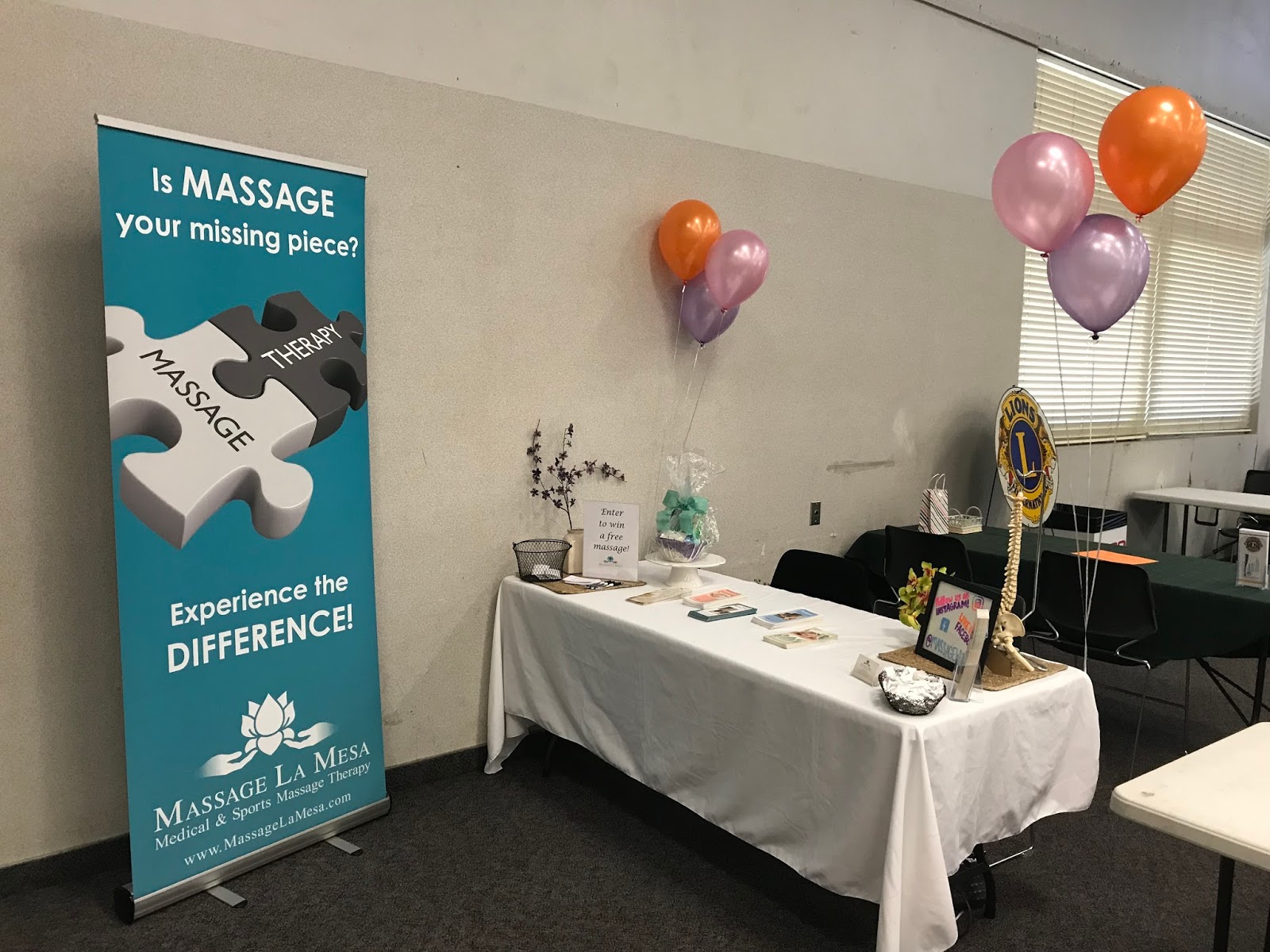
Thursday night was so much fun! Massage La Mesa attended our first business expo, which was put on by the La Mesa Chamber of Commerce. It was completely sold out and had businesses ranging from restaurants to moving companies to banks. The event was a great way to learn about a lot of businesses that you may not know
about in the community, and we would highly recommend all of you attending the next time there is one. It is just a great opportunity to learn more about your city and what it has to offer. Not to mention all of the free things that are given away. 

Every table that was there has something to give away to everyone and then a raffle item. We gave away a free massage and some products that we offer here. Others gave away Amazon gift cards or wine. Every table had something that was worth filling out a little card for! The restaurants were also giving our free samples of there most popular dishes, which is great if you haven't had the opportunity to try some La Mesa restaurants! There was also a silent auction and a 50/50 raffle drawing, which you could pay to participate in. 

All in all, there was something there for everyone. Being able to talk with some of the owners or employees of the businesses was great. They were able to answer all of your questions and give you more information than going to their website would give you. If you are a business owner yourself, getting a table at the La Mesa Spring Fling Business Expo would be a great way to get your business and your name out there to the community. We found lots of people that were in need of a massage, but just hadn't found the right place yet. We are hoping that by putting ourselves out there, we are able to find more awesome clients just like you that can be helped by our awesome therapists. Aside from all the great things that came out of it, it was so much fun. We had a gorgeous table and a great time hanging out with each other and some fellow La Mesa-ians! 

Keep a look out for future events put on by the La Mesa Chamber of Commerce because they will surely be a blast! Throughout this blog, you can see some fun pictures from the event of our table and of us repping our awesome shirts and signs!


Contact us at: 619-917-4675 OR  massagelamesa@gmail.com 


                                Book now by clicking HERE.

Monday, April 23, 2018

THORACIC OUTLET SYNDROME AND MASSAGE

Thoracic Outlet Syndrome
The thoracic outlet is the area between your collarbone and your first rib. In this area, there is a combination of nerves, arteries, and veins that can be seen in the picture on the right. When someone has Thoracic Outlet Syndrome, or TOC, those nerves and blood vessels are compressed. This causes serious symptoms within the person. 

What causes Thoracic Outlet Syndrome?
There are multiple different possible causes for TOC. Medicine Net describes some of these possibilities include trauma from a car accident, repetitive motion and injures from work or sport activities, defects within the anatomical system, such as having an extra rib, and pregnancy. There are cases when the doctors cannot pinpoint a direct cause for Thoracic Outlet Syndrome. 

What are the Symptoms of Thoracic Outlet Syndrome?
Mayo Clinic explains that the most common symptoms of TOC are pain in the neck and shoulder and tingling or numbness within the fingers. There are other symptoms that may appear depending on
what nerves and arteries are compressed within the thoracic outlet. 
These symptoms can include:

  • discoloration of the hands
  • pain and swelling within the arm
  • weak or no pulse in the affected arm
  • arm fatigue
  • weakness of the arm
  • weak grip
What is there treatment for Thoracic Outlet Syndrome?
In most cases, TOC is not life threatening and can be treated with physical therapy and pain management measures, such as medication, acupuncture, and massage therapy. The doctor will put together a specialized treatment plan that is determined by the severity and the blood vessels or nerves that are affected. In some cases, the compression is serious enough that surgery is required in order to begin blood flow to the arm and hand again. This is very rare though as most cases are treated with the above measures.

How can massage help with Thoracic Outlet Syndrome?
Massage can help with TOC by softening some of the fascia that surrounds the thoracic outlet. This helps to prevent any added compression on the outlet and relieve some compression by reducing the tightness of the surrounding fascia. Massage also helps to increase blood flow to the area. One of the biggest problems of TOC is the decreased blood flow to the arm and hand. According to Wakefield, by increasing the blood flow to the area, it makes more blood flow through the arm and hand. This is very helpful introducing the amount of swelling, tingling, numbness, and fatigue within the arm and hand of the affect outlet. 

It is important that you consult your medical professional before starting any treatment for Thoracic Outlet Syndrome. 


Contact us at: 619-917-4675 OR  massagelamesa@gmail.com 


                                Book now by clicking HERE.