Monday, October 30, 2017

COLD VS HOT THERAPY


Cold vs Hot

Let’s begin by introducing the technical terms for this subject.  Cryotherapy is the use of cold in treatment of an injury and Thermotherapy is the use of heat in the healing process.  Many of our clients come to us either with an acute injury, or because of a chronic condition causing pain or musculoskeletal dis-ease in the body. 

We will discuss cryotherapy first because it is the first response to Acute injury.  An acute injury could be a fall or a sprain, a broken bones, surgery, or even just a strained muscle during a workout, and the acute phase for treatment is the first 24 to 72 hours.  This is usually associated with the acronym R.I.C.E.- Rest, ICE, Compression, and Elevation.   Compression and elevation are passive parts of the post injury Rest phase.  If the injury is on a limb it is typically easy to wrap an ACE bandage around your wrist or ankle, that is the compression aspect and then raise the limb above your heart and prop it up to properly Elevate and Rest, this is the time to introduce Ice.  Ice helps to decrease pain and ease acute muscle spasms, it constricts blood vessels which decreases swelling, and decreases the inflammatory response.  Most conditions ending in –itis, arthritis, bursitis, tendonitis, the –itis indicates inflammation and ice can be helpful for these conditions. 

Conservative use of ice can protect against frost bite or nerve damage from over icing an injury and never use ice on an open wound or areas of poor circulation or neuropathy.  Ice packs whether gel or ice cubes should always be wrapped in a damp towel to increase conduction and protect the skin.  Time increments will vary based on the body part however areas with little muscle or tissue, feet, hands, ankles, and wrist are especially vunerable to frost bite so rounds of 5-10 minutes at most with 10-15 minute rest intervals in between ice is critical.   For the back, legs, and hips 15-20 minutes of ice is recommended with 10-15 minute rest intervals in between.  Your massage therapist may recommend using ice following a particularly intensive session of deep tissue work causing tenderness or inflammation from the work releasing chronic muscle adhesions or ‘knots’.

Chronic pain is typically defined as ongoing and lasting for more than six months.  Most chronic pain comes from initially from an injury or illness and is aggravated from persistent stressors, poor self care or general repetitive lifestyle hazards such as long commutes, poor posture, and sedentary work life 8 plus hours a day.  Massage is the best way to help the body maintain balance with the stressful demands of our busy lives, in between sessions thermotherapy can be a great way to help the body cope with the daily tension.  Heat acts to increase circulation, reduce stiffness and decrease muscle spasms.  It is great way to help relax tight muscles before stretching and during massage.  Conditions that respond well to heat include tension headaches, chronic shoulder or low back pain, frozen shoulder, and sciatic pain.  The most important thing is the find a way to work it into your daily routine.

My favorite recommendation for quick rounds of heat therapy is to use the little bean-bag packs you can
microwave, an easy as home “life hack” is to fill a single sock at least three quarters full of rice, tie the sock closed and toss it in the microwave for 45 sec, toss it over your shoulder for instant relief. Try warming it at work and using it on your commute home or while you are sitting at your desk in the morning checking emails. Most electric heating pads have auto off switches now and it is easy to keep plugged in next to the couch or bed and use at the end of the day when you finally get a chance to stop moving. For large muscle groups like legs, hips, and back at least 20-30 minutes is a good start and no more than 45 minutes using low heat, let the area rest by moving the heating pad to a different body part for 15-20 minutes then, if desired, a second round of heat on the first area.  If you have access to a hot tub, sauna, or even your home bath are all great options for adding heat therapy into your pain management routine.  I also recommend Epsom salts in the bath tub following a massage or for self care any time your body is feeling the strain.  Contraindications, meaning when heat is NOT recommended, include deep vein thrombosis, some neuropathy or circulation conditions, or when an infection or malignant tumor is present.  Always consult your physician before using a hot tub, sauna or Epsom bath if you have certain cardio/pulmonary conditions.  Discuss your specific conditions with your massage therapist, utilize our training as a resource for your questions and help maximize your healing with our suggestions for daily, self care using of cryo- and/or thermotherapy.


Contact us at: 619-917-4675 OR  massagelamesa@gmail.com 

Book now by clicking HERE.

UNDERSTANDING YOUR PAIN

Introduction to Pain Science
Understanding your pain

Pain can be debilitating.  Chronic pain brings 30 million people to the doctor yearly in the U.S.  50% of those in pain are unexplained.  In other words, the doctor agrees it is chronic pain but MRI’s, blood work, tests, or x-rays don’t show a cause for the pain, which brings us to the topic of pain and your brain.  Pain science has become increasingly popular in the manual therapy world.  A whole new way of approaching pain comes to light as more research and publishing’s on the topic arise. 

Pain is weird.  Pain is not caused by any ONE thing.  We need to stop thinking of pain in terms of a single cause, “It’s all coming from the knee surgery" (or you fill the blank).  Pain is not a reliable sign of what’s really going on.  Chronic pain is a bag of different factors, which are complex.  Pain always has a layer of brain-generated input, which can be helpful but also hindering.  In the worst cases, the pain system can malfunction in several remarkable ways, causing pain that is much more intense than just a symptom.  Sometimes, for many people pain is the problem. 
 
  •  When pain persists, the danger alarm system becomes more sensitive


From an early age we are taught that pain signals are a protective mechanism our body gives so we stop doing whatever is causing the pain.  This is easy to grasp if we’ve broken a bone or touched a hot stove.  It’s not so easy to understand when a person’s body is giving them pain and doctors can’t find anything wrong.  Or physiologically the bone is completely healed and therefore should not cause pain anymore. But pain is not FAIR.  It is a product of: tissue damage, perceived threat and personal history.  Pain can occur without identifiable tissue damage or it can outlive recovery so that even where tissue has healed, the pain persists.  For those in chronic pain, this becomes a self-sustaining pattern.  When pain persists, the danger alarm system in the brain becomes more sensitive.  When the alarm system becomes more sensitive you feel pain more because the body’s response systems and your thoughts and beliefs contribute to the problem.

·       Pain doesn’t always match tissue damage

Dr. Lorimer Moseley tells an entertaining story of a snake bite on his TED talk “Why things hurt” which illustrates pain can be an illusion and personal history has a big part in pain.  In this story he was walking along a trail and felt a scratch on his left leg near the ankle and thinking nothing of it, keeps walking.  It turned out it was a snake bite and he almost died.  Years later while walking in the same type of environment he felt a scratch on his left leg near the ankle where excruciating pain immediately ensued.  That time it really was just a stick that scratched his leg but his brain was telling him, “remember last time you felt this you almost died, this is an emergency!”  This example shows pain you perceive doesn’t always match the amount of seriousness or tissue damage. When something happens to our body, receptors send a signal to our brain to say “something just happened.”  Within seconds the brain decides for us if we should be worried about it based partially on past experience.  

·       Once a danger message arrives at the brain, it has to answer a very important question: “How dangerous is this really?” In order to respond, the brain draws on every piece of credible information — previous exposure, cultural influences, knowledge, other sensory cues — the list is endless.

Everything in your body that hurts involves a conversation between the central and peripheral nervous systems. I love this example from Pain Science.

It could go like this:
NERVES
Got problems here! Bad problems! Red alert!
BRAIN

Yeah? Hmm. Okay, so noted. But you know what? I have access to information – sorry, it’s classified but
It suggests that we don’t have to worry about this much.
NERVES
I’m telling you, this is serious!
BRAIN
Nope, I don’t buy it.
NERVES

Look, I may not have access to this “information” you’re always talking about, but I know
tissue damage, and I am not kidding around, this is a credible threat, and I am going to
keep telling you about it.
BRAIN

Actually, you’re having trouble remembering what the problem is. You’re going to send me fewer
messages for a while. Also, these aren’t the droids you’re looking for.
NERVES

Uh, right. What was I saying? Gosh, it seems like just a second ago I had something important to say,
 and it’s just gone. I’ll get back to you later I guess …


I want to be very clear that this is not suggesting the pain people feels is all in their head and isn’t real, rather by explaining the way the brain works we can reassure people that the danger implied by pain maybe exaggerated.

Many people with chronic pain want to “avoid pain” so they don’t do the movements that cause pain.  If pain weren’t complicated this would be a good idea but as we’ve discussed, pain has many areas involved so this approach isn’t the best and leads to limited activity and less quality of life.  For ideas of how to move with your pain reference Lorimer Moseley’s book, Explain Pain.  In a nutshell, the idea is to retrain your brain that you are safe and the movement is not causing you damage. An example of this would be if you have neck pain turning your head.  I’m not going to ask you to turn your head.  Instead I may have you sit on a swivel stool and look at a fixed spot on the wall while swiveling your body left to right.  You neck is still moving but your brain sees this as a safer movement therefore no pain!  For any body part the idea is to start with comfortable movements below the flare up line and always do more than you did yesterday, but not much more.  There will be a line where you flare up, but this line will slowly raise along with the amount of activity you can accomplish.   Here are a couple thoughts about moving within your pain zone. 

·       Be kind to your nervous system. Create pleasant, safe sensory experiences — positive inputs. Seek comfort.  If your brain thinks you’re safe, pain goes down — and pleasure feels safe. So be “nice” to your CNS in every way that you can think of.
·       Don’t be a pain drama queen.  When you exaggerate, talk about and dramatize your pain, you directly exacerbate the neurological end of the chronic pain problem. 

With a little education and understanding why your pain won’t harm you, you can overcome pain and return to doing the things you love by slowly adding smart activities to your life.  Be patient and purposeful in picking activities which feel good and kind to your body and your brain will follow.  You can master this.  The research shows that it works.  


Contact us at: 619-917-4675 OR  massagelamesa@gmail.com 


Book now by clicking HERE.

Monday, October 23, 2017

STRAINS VS SPRAINS

Strains Vs. Sprains
Two words that sound so similar but are actually completely different. Sprains and strains are often used interchangeably or incorrectly because a large amount of people do not know the difference between a sprain and a strain. Don't want to be one of those people? We got you covered!

What Are Strains?
A strain is commonly referred to as someone pulling a muscle, and it really is just that. A strain is the overstretching or tearing of a person's muscles or tendons. What exactly is a "tendon" some may ask. Well, a tendon, according to MayoClinic, is a fibrous cord that connects all of our muscles to the bones in our body. People most commonly find their lower back and hamstring muscle (muscle in the back of the thigh) strained.

What Are Sprains?
Sprains are more common and can happen in the strongest, most athletic of people and in people who have never even worn a pain of sneakers. A sprain is the overstretching or tearing of a person's ligaments. A ligament is a group of tough bands of fibrous tissue that is used to connect two bones together. The most common body part that is sprained is the ankle. Side Note:I just recently sprained mine!

Symptoms of Sprains and Strains
I bet you are thinking "Well, thanks for telling me what they are, but how do I know if I sprained or strained my -insert body part here-?" Great question! Almost all of the symptoms of sprains and strains are the same for both and can happen whether you sprain or strain. These symptoms include pain around the affected body part, mild to severe swelling, limited flexibility and range of motion, and limited strength while using the affected body part, according to Health Line. The symptom that is usually a good tell-tale sign of whether someone sprained or strained a body part is if there is bruising or spasms. If a person sees bruising around the hurt body part, then it is probably a sprain. If the person is experiencing muscle spasms of the affected area, then it is most likely a strain. Although this is usually a good indicator, always consult a doctor for proper diagnosis and treatment plan. 

Treatments of Sprains and Strains
For both sprains and strains, the treatment is generally the same unless it is clarified by a medical professional. RICE is going to be your best friend if you sprained or strained part of your body. RICE stands for Rest, Ice, Compression, and Elevation. Kids Health goes into more detail about RICE. To follow RICE, you must rest from any strenuous activity or standing for long periods of time until the pain is significantly less, ice the affected area 4-8 times a day for no longer than 20 minutes at a time, support the injured area with compression bandages for at least 2 days following the injury, and elevate the affected area above the heart as much as possible to reduce swelling. In some cases, more advanced treatment may be required under the supervision of a medical professional. We recommend that if there is severe pain to see your doctor and to not self-diagnose.


Contact us at: 619-917-4675 OR  massagelamesa@gmail.com 


Book now by clicking HERE.


Monday, September 25, 2017

FATIGUE AND MASSAGE

Fatigue.
 Everyone has experienced it at one time or another in their life. Some people experience it on a regular basis. However often you feel tired or fatigued, massage can help to get you some rest and relaxation that you and your body desperately need. 

What is Fatigue?
Fatigue is the feeling of being overworked or overtired, according
to Mayo Clinic. Fatigue can be so bad for some people that rest or sleep does not relieve the feelings of fatigue. Fatigue over long periods of time can reduce your energy, your motivation, and your concentration making daily life extremely difficult. It can also impact your overall psychological and emotional well-being, as well, which could make you irritable, irrational, and have uncontrollable mood swings. Fatigue can also be extremely cyclic. For example, a person can become fatigued, which makes it harder for them to concentrate. Because they are having difficulty concentrating, they have to work harder to do their job and are stressed out about their job performance. Now they are working harder and are stressed out, so they begin to have difficulty sleeping. This ultimately makes them more fatigued, and the cycle begins again. Because of it's cyclic nature, someone dealing with fatigue has to find a way to stop the cycle.

What Causes Fatigue? 
The causes for fatigue are endless. Like was discussed above, stress caused by life can cause fatigue. Fatigue can be caused by many different diseases, conditions, or illnesses. According to Medicine Net, some common causes of fatigue are anemia, asthma, depression, insomnia, arthritis, obesity, flu, and even the common cold. With the cold and flu season approaching, it is important to remember that fatigue is very common when fighting illnesses, so if you suddenly feel fatigued, it may be time to try and boost your immune system. Fatigue is also commonly associated with Seasonal Affective Disorder, which often happens during fall and winter. No matter what the cause of fatigue is, the natural remedy that will be discussing today works for all causes. 

What Can Help With Fatigue?
There are multiple natural remedies to try and help with fatigue, but today we are going to be talking about massage. Massage is a proven natural, alternative remedy to help treat fatigue. Pacific College of Oriental Medicine explains how massage therapy is one of the most highly recommended alternative treatments for fatigue. Massage helps to turn off your "fight or flight" response and turn on your "rest or digest" response to allow your body to finally relax and begin to heal itself. When the body is fatigued, it is in a constant state of stress, which takes away from the bodies natural healing system. Allowing your body that time to decompress and relax, helps your overall well-being and health. According to New Yew Healing, massage can also increase mental clarity and sleep, which both helps to reduce the feeling of fatigue.  

Personal Note
Like I said earlier, fatigue is something that almost everyone has experienced at some point in their life. I just recently felt the effects of fatigue and life. 

I broke my foot in early July and finally, got out of my cast and boot at the beginning of September. Although it was wonderful to finally be able to walk completely on my own again, I had to begin the draining process of physical therapy and working out after months of inactivity.

Between waking up at 3:30 to go to the gym with my husband, going to physical therapy twice a week before work, working, going to school full time, and still maintaining my home life, I was absolutely fatigued and overall, just drained. I found myself lying awake at night constantly thinking about the things that I had to do the next day or feeling the discomfort and pain from physical therapy, which added to my fatigue. 

Finally, after 2-3 weeks of feeling fatigued, I found myself on Sydney's (one of our awesome therapists here at Massage La Mesa) table. Between the pain relief and the relaxation, I went home that day and went to bed at 7 pm and didn't wake up until 7 am the next day. Even though I skipped a workout, it was wonderful to finally feel rested and no longer fatigued. I went to work the next day feeling like a new person. Since my massage last week. I have been sleeping better and have been able to better cope with my sometimes hectic life. 

The reason I am telling you all about this is because I am a huge advocate for massage, and I still sometimes find myself not using massage like I should. I know life can be crazy and overwhelming, and that is usually the hardest time to make time for massage. However, when life gets crazy like that, it is so important to find that time for yourself and for your body because it might just be the pick-me-up that you needed!


Contact us at: 619-917-4675 OR  massagelamesa@gmail.com 


Book now by clicking HERE.


Friday, September 22, 2017

OUR FIRST FOAM ROLLING WORKSHOP

This blog post is going to be far more personal and less informative than all of our other blog posts are, but we are so excited about our workshop that we had to let everyone know about it!

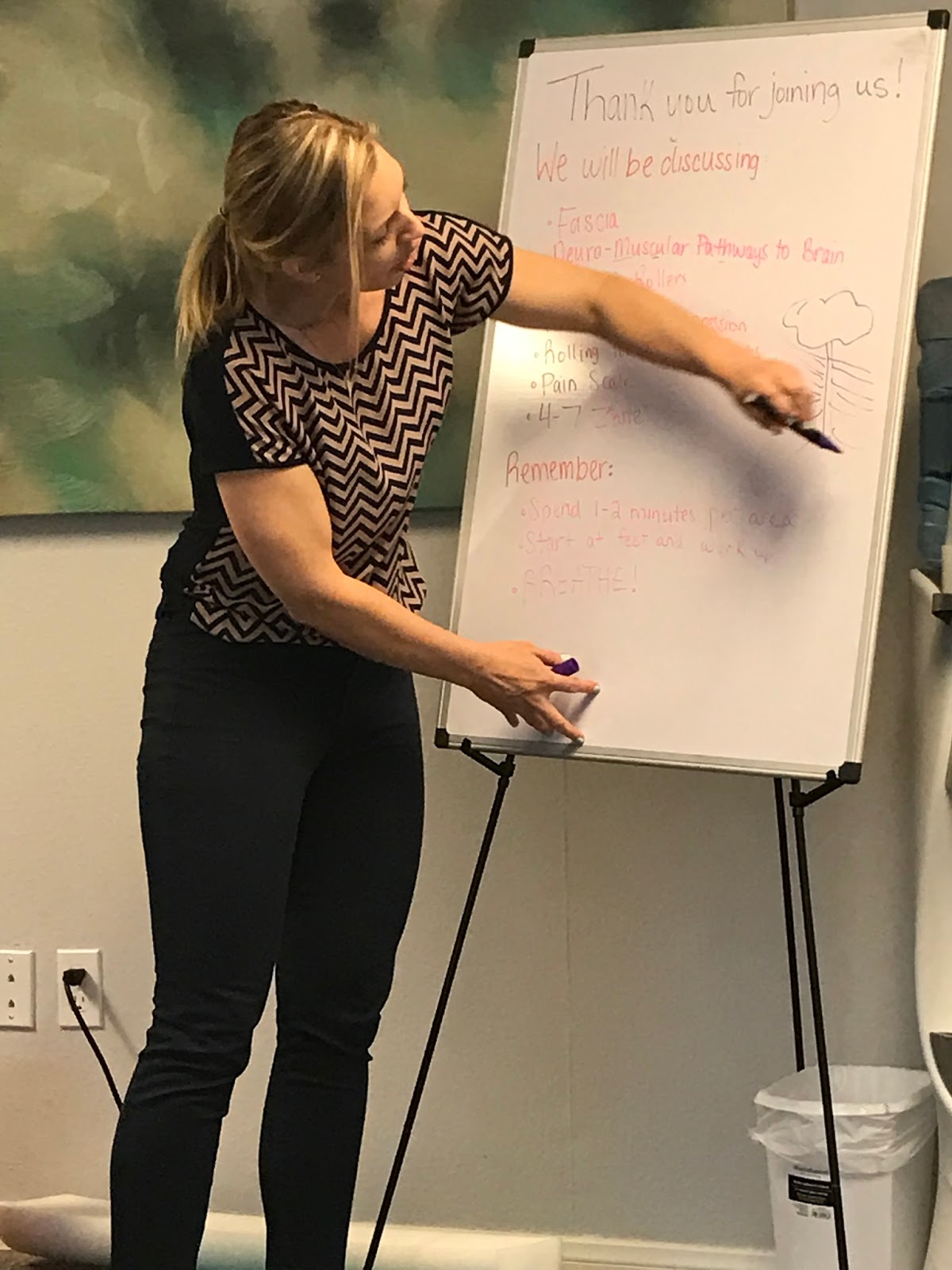
Last Saturday, we held out first Foam Rolling/Self Myofascial Release Workshop in our clinic here in La Mesa. We had four clients show up, which was super exciting for us! Sydney, one of our therapists here, also came to show her support, and of course, the teacher of the class, Angela, was there. 
All in all, we had a great turnout with just the right amount of people to make a fun filled class that was personalized for each client.

Angela started the class by delving into what foam rolling is and why it is so important. After some talk about the informative part of Myofascial Release, we jumped right into the fun stuff!

From our toes up to our heads, we worked on our major muscle groups and common problem areas for our clients that attended the class. During this time, Angela made sure to find out everyone's limits, so that she could adjust each exercise to fit each person. For example, one of our attendees had a rotator cuff problem, so they found it difficult to hold themselves up for some of the exercises. Angela found a way for them to still perform the exercise without putting unnecessary strain on their
shoulder.


Another fun part of the class was getting to try out and learn about all the different types of foam rollers. This helped to figure out which one worked best for each person. With this information, we
had two attendees go out and buy a foam roller after the class!


As the class came to an end, everyone was sent home with a Self Myofascial Release tool and a worksheet showing pictures and descriptions of all of the exercises we went over in the workshop.

We were so happy to have a great class full of clients with awesome attitudes and a desire to learn and benefit from foam rolling. We hope more people have the chance to experience our awesome workshops in the future, and if you would like more information about foam rolling, click here to visit our Introduction to Foam Rolling.


Contact us at: 619-917-4675 OR  massagelamesa@gmail.com 


Book now by clicking HERE.


Monday, September 18, 2017

INTRODUCTION TO FOAM ROLLING


Why Foam Roll
Foam rolling is a form of self-myofascial release, or self-massage, that gets rid of adhesions in your muscles and connective
tissue. The fascia is a thin layer of connective tissue covering every muscle.  The adhesions can create points of weakness or susceptibility in the tissue.If the muscle isn’t contracting uniformly from end-to-end, it could lead to injury and pain.  Foam rolling also increases blood flow to your muscles and creates better mobility, helping with recovery and improving performance.

In addition to getting fresh blood flow to the area you are rolling, you may be changing the neuro-muscular pathway to the brain which tells this area of the body not to hurt anymore.  Foam rolling may fire up your central nervous system which registers and reacts to pain. Like massage, foam rolling stimulates pressure receptors beneath your skin, says Tiffany Field, director of the Touch Research Institute at the University of Miami. “When you stimulate those pressure receptors, that stimulation increases vagal activity in the brain, which has been linked to relaxation of the nervous system, reduced levels of stress hormones like cortisol and improved pain tolerance,” she explains.  In other words, foam rolling may be knocking out stress and quieting your body’s pain-detection centers.

Types of Foam Roller and Other Myofascial Release Tools
Foam rollers are in every gym and fitness center in many different forms, colors and lengths.  There are different densities of rollers along with flat or bumpy surfaces, and rollers with deep grooves and knobs.  When beginning it is best to stick with a softer foam that is smooth in appearance with no obvious bumps or grooves on it.  These basic foam rollers are often white in color.  As your body gets used to foam rolling you may want to advance to a roller with foam that is more dense or has bumps on it. 

Besides having or using the gym’s foam roller it’s beneficial to use a smaller tool for more specific self-massage in areas that need pointed pressure.  Having a tennis ball, lacrosse ball or racket ball are perfect for these more specific releases that the muscle may need.  The arch of the feet, the neck muscles at the base of the skull, and the deep muscles in the Glutes are some examples of where these balls may come in handy.  Some areas respond better to a softer ball and some areas need a smaller and firmer ball to get into the deeper layers, especially in the forearms. There are specific myofascial release/massage balls on the market and they work great but for the added cost one of the above-mentioned balls work just as well.  You can usually find something around the house, golf ball, kids super bouncy ball and even a piece of fruit in a pinch. 

How Do I Foam Roll and For How Long?
When rolling or working on tight/sore muscles you will experience discomfort or pain. Think of it like the pain you get while stretching. It should be mild to moderately uncomfortable, but not unbearable, and when you are done it should feel better.  Similar to while receiving a massage the pain scale 1-10 is used while foam rolling.  With 1 being very little to no pain or discomfort and 10 being the worst pain you’ve ever experienced, you want to work within the 4-7 zone while foam rolling.  Spend time on the areas that are sore.  These are the areas that need work.  Err on the side of less pressure. 

Don’t roll too quickly.  While it might feel great to roll back and forth on a foam roller quickly, you aren’t getting the full benefit of your rolling session or lasting results.  You need to give your brain enough time to tell your muscles to relax.  Spend 1 – 2 minutes on one area or hold until a release is felt.  Like a trigger point release during a massage, if you feel the pain number drop on your pain scale, you are ready to move on to the next spot.  Focus on the areas that are tender, they need work.  This may sound daunting but in ten minutes you can have a very effective foam rolling session.You may come to love it and spend longer because it feels good and the results speak for themselves.  The pain you feel while rolling will be gone in one to two weeks of daily foam rolling sessions.

Don’t Forget to Breathe While Rolling!
Foam rolling and Self Myofascial Release can be done anytime that is convenient for you.  Remember, rolling after exercise is better than before and foam rolling is great as a mid-workday break, or as a “wind down from the day massage” before bed to release tension.  


Contact us at: 619-917-4675 OR  massagelamesa@gmail.com 

Book now by clicking HERE.

Monday, September 11, 2017

THE IMPORTANCE OF SKIN-TO-SKIN CONTACT

Skin-To-Skin Contact is Needed for Health!

Everyone loves to be touched. It is a proven fact that touch is
important, and any type of touch from a handshake to a huge hug to a massage from a therapist, touch is extremely important to everyone and their bodies, as well.


Skin to skin contact can be a great way to improve your health and wellness. This can include hugs, massage, or even hand holding. According to Women's Health, the touch between two people releases both serotonin and dopamine. Both of which are instrumental in overall happiness and emotional well-being within the body. It also helps to make you feel less stressed and anxious. Studies have shown that another way skin to skin helps with health and wellness is by lowering blood pressure and heart rate and by boosting your immune system, and by giving you pain relief, according to NPR.

Babies and skin to skin contact

From the time a baby exits the womb, he or she craves and needs to be touched. Studies have shown that allowing the baby to immediately have uninterrupted skin to skin contact with mom can help to stabilize their respiration and oxygenation, increase their glucose levels, warm the infant, reduce stress hormones, regulate blood pressure, decrease crying, and increase the quiet alert state,

according to MedScape. Without skin to skin contact, the baby's immune system can suffer and make them susceptible to illness because of the high levels of stress hormones that are release when a baby feels stressed and vulnerable due to lack of touch, affection, and love. Allowing an infant to have skin to skin contact with mom immediately after birth also allows for a stronger bond and connection between mom and baby and helps to calm the mom after childbirth.

Adults need to be touched too...
Although it is not thought of often, physical contact is a basic necessity for living. Many think of it as not a big deal, but for many people, they can go days without any direct skin to skin contact. According to Psychology Today, three out of every four adults agree with the statement "Americans suffer from skin hunger." Skin hunger is the feeling of loneliness or the lack of physical affection that one requires. Many people find themselves longing and craving for skin to skin contact that they just to not be able to get or to get enough of.

Massage is a great option for those requiring a fix of being touched. Anyone who has regular massages can tell you if you’re feeling stressed and anxious a massage will soon calm you down. Although many people require massage therapy for many other physiological reasons, like chronic back pain or migraines, massage therapy for the contact is common, as well. Relaxation can be found through the contact that you get from your massage therapist.
Being massaged makes your muscles un-clench if you’re all bunched up. If your blood pressure is high, it can actually drop after a massage and cortisol levels (a stress hormone) will drop. Because you’re nice and relaxed, your body has the breathing space to start recharging your batteries so that you’ll feel much better afterwards.

Recent research backs this up; the immune function of healthy adults who got either a 45-minute Swedish massage or 45 minutes of lighter touch were measured and the group who enjoyed a massage were found to have significantly higher numbers of white blood cells - including the cells which help the body fight viruses. So can a massage stop you catching a cold? The scientists stopped short of saying so, but it does seem that regular skin to skin contact through massage could play a part in keeping your immune system healthy and fighting off bugs.

The evidence is mounting up that a massage helps you feel good, improved your overall well being and boosts your immune system. Why not book one today?


Contact us at: 619-917-4675 OR  massagelamesa@gmail.com 
Book now by clicking HERE.